Showing posts with label primary schools. Show all posts

01 October, 2011

The Singlish Dilemma


I cringe every time I hear my children speak Singlish. “I cannot lah,” they’ll say or “Why so like that one, ah?” And then, there are these definite shudder-inducing phrases, “mummy, today eat what”, “I already eat” and “can go or not?"
Courtesy of theAsianparent.com
Now, before you get all worked up, this article is not about dissing Singlish or Singaporeans.  It is rather about the challenges we as Singaporeans face when it comes to speaking proper English. Without a doubt Singlish has become very much a part of our identity today, and I am not an advocate of eradicating it; we all know how useful it can be. The real dilemma is in how to encourage the use of proper English, while not necessarily eroding our Singlish heritage.
At the launch of the recent “Speak Good English Movement” initiated by the government earlier this month, Minister of State Mr. Lawrence Wong, said that the objective of this year’s movement is to “enable every Singaporean to speak Standard English – that is grammatically correct, commonly understood around the world and intelligible to English speakers everywhere.”
When I met with Mr Goh Eck Kheng, Chairman of the movement, he was quick to point out that “Singlish has a role in Singapore and is a marker of Singapore’s identity.” He emphasized that “we are not here to eradicate Singlish but to promote English because it is an advantage that we already have in the international community and it is something we cannot afford to lose.”
So, why do we have so much difficulty speaking in a language that is recognized by the international English community?
Mr. Goh believes it all boils down to the mind-set.  “You can speak in simple English even if you are at the hawker or to the taxi uncle. Try saying Uncle may I have some chilli? instead of ‘Uncle, chilli.’”
He stresses it is important that those who can speak well must not give in to societal pressure to “dumb down” their language. Instead they should serve as role models so that the standard of English in Singapore is elevated. He also advocates that one must know how to switch between Singlish and proper English, and learn to effectively use both languages to build relationships under appropriate circumstances.
Georgina Knight-Hassel and her husband, Chris, have been living in Singapore for the last 14 years.  Originally from the West of England, the couple settled in the heartlands of Singapore.  When their older daughter, Elizabeth, was younger she spoke in Singlish despite her parents being native English speakers.  Her mother explains that this was mainly due to her social activities with the local children in school and at the playgrounds.  But during her visits to England, Elizabeth realized that her British cousins and relatives could not understand her ‘colloquial English’. She quickly became aware that if she was to be understood elsewhere, she needed to speak in proper English.
Her younger sister, Lily, on the other hand, was more influenced by Georgina’s presence and spoke in proper English.  But when she entered a local primary school, she too began to speak Singlish.
Are they “dumbing down” as Mr. Goh suggests? Definitely not, said their mother.  ”The girls are merely trying to fit into their environment.”  She adds that both girls, now 7 and 11, have learnt how to easily switch between Singlish and British English with ease.
What about our local kids?  Can they learn to switch too?
Mr. Goh believes they can.  With good role models, he assures us that little children can differentiate languages by listening and absorbing them.  For families who do not have a strong foundation in English, Mr. Goh suggests these options:
  1. use the mother tongue to converse with the kids
  2. outsource or find good English speaking role models for their children in enrichment centres or schools
  3. children will recognize the efforts of their parents or caregivers when they consciously try to speak proper English and will follow suit.
  4. allow the children to influence and help the adults at home speak better English.
Adel Ang, Channel Sales Manager at TREND Micro, has two kids, 3 and 5, who correct the way she speaks English.  She confesses that sometimes she doesn’t “feel at ease” when her kids correct her, but admits it has made her more conscious of the way she speaks English around them.
So, is it a parenting or an education issue?
Some parents like Ms Ng Yi Ling try to impart good English speaking skills to their children but say their efforts are thwarted whenever someone speaks Singlish to them.  Others like Ms Mei Loh blame it on impatience. “Children can be impatient to get the message across so they resort to using wrong grammar; parents are impatient too so they often fail to correct them.”
It seems it takes a conscious effort from parents, schools and the public in general to enable our children to speak in proper English AND be able to switch to Singlish when needed.
“Speaking in proper English is speaking in proper sentences,” says Georgina.  “While the school teaches them the technical aspects of grammar and vocabulary, as parents, we can supplement this education with guidance and encouragement as well as giving them opportunities to practice speaking in proper English.”
Georgina shares some tips she uses to help her kids speak in proper English.
  1. Be aware and conscious of the way you speak around your child
  2. Allow the child to hear conversations in grammatically correct English
  3. Don’t correct your child each time he/she speaks
  4. Remind them to speak clearly, not to mumble, and to pronounce the endings of their words
  5. Practice makes perfect – have conversations with them
  6. Encourage your child to finish his/her sentence
  7. Discuss, debate and/or talk about the difference between colloquial and proper English
  8. Give them the freedom to clarify the pronunciation of words – (eg. American or British pronunciation of tomato or mischievous)
Sure, my kids will continue to speak in Singlish.  They are Singaporeans after all. And I know I will continue to reply, once in a while, with my usual sarcastic “Excuse me? What did you just say? I don’t quite understand you.” But I’m pretty confident they are able to switch and speak in formal, proper English when required.  And that, I suppose, is fundamentally the most important thing we need to ensure.
——————————————————————————————
There are many more great tips and insights on the official website of Speak Good English movement. As with the learning of any language, it takes time, patience and perseverance to master a language. Share with us how you encourage your kids to speak proper English.

This article first appeared in theAsianparent.com

30 September, 2011

The 15-minute birthday party


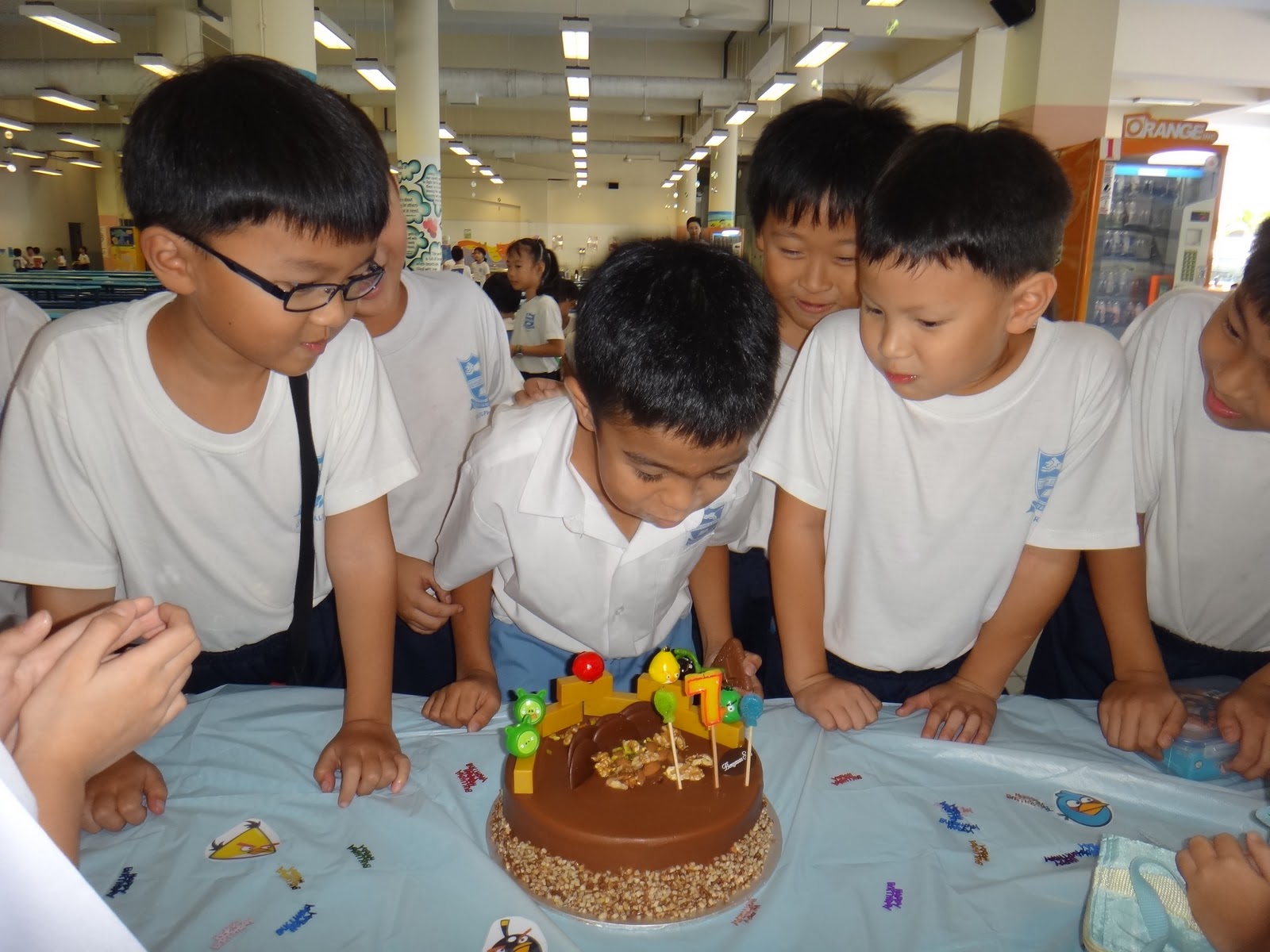
Today I threw a birthday party for my son.  For a party with 30 kids, it was over all too soon!

This whirlwind party was the quickest and easiest party I have organized.  All that was needed was a cake, some table decorations, goodie bags full of unhealthy snacks, and a bit of luck - catering to 30 seven-year-olds is no mean feat.  

My seven-year-old son, Krysh wanted a "playable Angry Bird cake", so I bought his favourite chocolate cake (from Bengawan Solo) and decorated it with Angry Bird toys bought from the local peddlers.  His classmates sang him a birthday song, the cake was cut, and devoured! Some even asked for seconds - there were no left overs!

Kids love goodie bags. And when the birthday boy distributed the goodie bags, there were squeals of delight! Mamee noodles and chips - sorry moms, but the kids LOVE them.  And of course an Angry Bird multi-coloured pen!

And then, they were off to play with the cake toppings!! 15 minutes! And the party was done!

We left the kids in school, all happy and pumped up with sugar, MSG and adrenaline... (Sorry teachers, we hope they didn't give you too much trouble).

Matthew treating Krysh to an orange juice! 


21 September, 2011

How do you choose between two loves?


Two words. Tenacity and Compromise. 

I love this movie. Aside from being a huge fan of the incredibly likeable Sarah Jessica Parker, who plays the movie's lead role Kate Reddy, this movie speaks volumes to me.  

I was excited to watch it as soon as I saw the trailer.  I could relate to Kate and completely understand her emotional turmoil to be physically and emotionally present for her children AND fulfilling her professional dream at the same time.

I love my kids.  I love my job.  How do I choose between 2 things that I love?  Must I make a choice?

As always, LIFE throws you curve balls, and watched while you agonize over your decision to choose or compromise.  The invitation to the movie preview fell on the same day as the annual Mid-Autumn Festival at my son's school.  This festival was a big event for the school and was organized by the Parent Support Group (PSG or PTA equivalent).  It was a major fundraising opportunity for the PSG as well as a chance for families to bond. 

As a parent volunteer who had reduced my volunteer hours due to work commitments, I had promised the PSG committee that I would help out at this event.  I had even made plans to put in my hours manning the game station, and then spent quality fun time with my kids at the Festival.  

With the movie preview, these plans had to be revised.  The night before the Festival, I sat down with my kids and helper (my husband was out of town - remember the curve ball?) and we discussed the 'new' plans.  

Like an army sergeant, I gave them their marching orders.

My son will bring his mobile phone to school so that he can call me and know where to find me after school is out at 5pm.  I will be at school at 3:30pm to help with setting-up of the game stall.  My helper and my daughter will leave the house at 4:30pm and join me in school at 5pm. 

All parties have to regroup at 6:30pm and we have to absolutely leave the school at 6:45pm for me to drop them home.  That would give me a comfortable 30 minutes to rush downtown from the East, in time for the movie preview.  

On that day, it was all systems go.  Things went according to plan, except for one minor detail.  I had forgotten to instruct them where to meet me at 6:30pm.  As I frantically dialled both my son and helper's phone numbers, I was scanning the faces of the hundreds of students and adults milling around the school, hoping it will be them.  And of course, they were not and they were not answering their phones.  Darn it!  We are on the clock here, people!

I could feel my panic button being pushed, as I tried to focus my thoughts and think of contingency plans.  Then on the sixth try, my helper answered her phone.  And miraculously, my son was with her!  Yea! We are only five minutes behind.  

"But Mom! We still have to redeem our prizes!" cried my son.  We rushed to the redemption room, picked out the prize and sped off to the car park.  By the time I dropped them home, I had only 15 minutes to get to my movie preview.  This was no easy task considering that I'll be driving in after-office-hours traffic on a Friday.

I Don't Know How She Does It © 2011 The Weinstein Co.
I'm happy to say that I got to the preview breathless, but with a minute to spare. And yes! I bribed the children with cotton candy and home movie so I could have a night out with my friend to watch this preview.


"I Don't Know How She Does It" opens on 22 Sep with a stellar cast Sarah Jessica Parker, Greg Kinnear, Pierce Brosnan, Olivia Munn, Seth Meyers, Kelsey Grammer, Christina Hendricks and Jane Curtin 


17 September, 2011

When Should Kids Have Their Own Mobile Phone


Nine-year-old Emma Knapp and her sister, Margot, 7, go to school two blocks from their home. They both carry a phone each to school. While Emma uses it sparingly to call her mom to pick her up after sailing lessons, Margot loves to get social calls from her friends.
Pat Kwek gave her only child a mobile phone when she was in Primary-three (P3). “She needs to walk home (alone) after school; the phone’s for emergency use,” she explains.  But she confessed that her daughter, now in Primary-five (P5) “has increasingly been using it excessively after school” and has now decided to confiscate it.
Courtesy of theAsianparent.com
Nelawati Moohamad Hock’s 9 year old son has had a mobile phone since he was in P2.  The mother of 3 gave her eldest son a phone so that she can communicate with him between her drop-offs and pick-ups to and from school.   “[Also], if we are going out, I usually hold his two younger siblings and he ends up walking by himself, following behind me.  In case he gets lost in crowded places, he can always call me. So far, he’s been responsible,” she adds.
While some parents feel that it is prudent to give their kids a mobile phone to stay in touch, others like Madelene Tan is holding off the inevitable for as long as possible.
“I don’t see a need for mobile phone since he takes the school bus and goes to student care after school,” she said of her primary one child.   Martha Chan Liebman agrees.  Her nine-year-old son does not have a phone and hasn’t asked for one yet.  But she concedes that she would give him one “when she deemed it necessary.”
Evelyn Koh has not given any to her kids yet, but is thinking of doing so when they start going for tuition, while Lee Li Kian said she prefers her children “use [the] coin phone in school if they ever need to call.”
While parents are divided over the age their child should own a mobile phone, there is no denying that the mobile phone is increasingly becoming a necessary accessory for the new generation. But where does one draw the line? Are primary school kids too young to own a mobile phone or can they be trusted with the responsibility that comes with it?
Guided ownership
Parents like Jack Loo, doesn’t think it’s an issue.  He gave his daughter her personal phone when she started primary one, but clearly stated his rules to her.  She cannot bring the phone to school and is allowed to carry the phone only on school excursions or outings with her friends or cousins, without her parents present.
Loo is the Director of Alpha Telecom Pte Ltd, a SingTel exclusive retail partner at Funan Centre and has been in the telecommunication industry for over 20 years.  He has noticed a tremendous change in the landscape of mobile phone sales in the last two years.  “Parents are buying Smart phones for their kids as incentive for good grades or behaviour,” he said.  “Even the Blackberry, formerly known as an Executive’s phone, is now popular among teenagers because of its social media properties. They can Tweet, Facebook and MSN each other easier, faster, and with the data plan, for FREE.”
Basic phones are best suited for kids
But SMART phones can be a distraction for a young child.  Loo advises parents to opt for a simple, basic phone for their younger kids to eliminate any gaming temptation or penchant to abuse their calling privileges.

He also recommends getting a pre-paid SIM card for their child’s phone to avoid what he calls a “bill-shock”.  While some parents worry about the lack of funds in the pre-paid card, Loo reassures that the pre-paid card will prompt the user when the funds are low and need replenishing.
Is Cell Phone safe for my child?
The decision to give a personal phone to a primary school student is very much dependent on the family’s needs (as expressed by parents above).  However, aside from the usual warning against obvious risks like giving out phone numbers to or taking calls from strangers, there are other potential hazards.
Earlier this year (May), the World Health Organization (WHO) issued a health warning regarding the potential dangers of cell phone radiation.  While the findings remain controversial, they are sufficient to cause some countries like Finland and France to be concerned enough to issue public warnings.
Experts like Devra Davis, epidemiologist, author (Disconnect: The Truth about Cell Phone Radiation) and founder of the Environmental Health Trust,  are concerned that our children are exposed to cell phone radiation at an earlier age and over a longer period of time, and because their nervous systems are not fully developed, they are more susceptible to the effects of radiation.
Still, with inconclusive findings and insufficient research done, we are still in the dark whether this is a real threat or just another scientific spoof.
Another concern that is gaining grounds among parents is the usage of text slang in messaging.  While there is some worry that frequent use of such slang may affect their children’s ability to read or write properly, parents seem to be more anxious about text abbreviations becoming a communication barrier between them and their children.
Decoding our children’s txt messages
Text slang used by kids comes in the form of acronyms, abbreviated words, numbers, letters and symbols for sounds.  We are familiar with common ones like LOL (Laughing out loud), OMG (oh my god), 121(one to one), and gf / bf / bff (girlfriend / boyfriend / best friend), but here are some of the sporadic ones that may pop up in your child’s phone:
  1. I h8 txt msgs – I hate text messages
  2. Gr8 / W8 – great / wait
  3. W/E – whatever
  4. RUOK – are you ok?
  5. Cmb – call me back
  6. CUL – see you later
  7. TTLY – Totally
  8. xlnt – excellent
  9. hldmecls – hold me close
  10. 2bctnd – to be continued
  11. Iowan2bwu – I only want to be with you
  12. Roflmao – rolling on the floor, laughing my ass off
  13. Cu2nite – See you tonight
  14. WYSIWYG – what you see is what you get
  15. IWYWH – I wish you were here
  16. JC – just chilling
  17. KWIM – know what I mean
  18. PITA – pain in the ass
  19. IDC / IDK – I don’t care / I don’t know
  20. GTG /G2G – Got to go / Get together
While the mobile phone has brought about unprecedented ease and convenience in terms of communication, the potential hazards are very real. There can therefore be no clear cut rules on when your kid should have that first phone. All we can probably do is try and limit the potential dangers and misuse as best we can.
This article first appeared in theAsianparent.com.

06 September, 2011

Fostering a positive attitude towards learning


All of us have an emotion towards learning. While some kids love to study and learn (literally), the majority enjoy learning in a fun and playful manner.
But for Singaporean parents, play is a “taboo” word that just does not go together with learning. “When my child is playing, how can he/she be learning or studying?” they protest.
That’s where Roderick Chua disagrees. Psychologically speaking, he says, we all learn best through play; that’s why in adult classes, we are encouraged to play games and interact so that the learning is better absorbed. The key issue then, is to have focus play.
The consultant and head coach at Edu.Quantum has had more than 20 years of experiences teaching, coaching and guiding youths as a tutor and pastoral counsellor. Currently pursuing his master degree in psychology, Roderick is interested to enhance the emotional attitude of his students towards learning.
What are your child’s feelings towards studying?
Roderick explains that the taxing education system in Singapore drives parents to enrol their child for tuition or enrichment at the first sign of a dip in grades or out of fear that their child couldn’t cope.
When befuddled parents question Roderick about their child’s poor grades or learning attitude despite the numerous tuition or enrichment programs they have engaged for them, he would turn the tables on them and ask: Does tuition build up a positive emotion towards learning? If the answer is no, then the tuition is ineffective.
He adds that oftentimes, the children feel that there is very little disregard for their feelings towards learning. The kids may feel resentful that their rights to play or free time have been violated. Homework is a chore, and they feel that they are forced to do things (i.e. go for tuition) that are not to their liking or decision. This, he said, is the beginning of a negative emotion towards learning.
Thus, for a child to learn well, we should access the level of emotional association the child is at towards learning – is it positive, negative or neutral?
Implementing play in learning
3495353 xxl 199x300 Promote a positive learning attitude in your child
When a child becomes sensitive to learning, he/she will have adverse reactions to learning or even doing homework (read Help your child to like homework). Some of these reactions include dislike to do homework, untidy handwriting, poor grades despite preparation and taking shortcuts in their work.
Roderick explains that there is a difference between learning and studying. The former is fun and enjoyable, while the latter is hard work. Thus, in order to encourage positive feelings in a child towards learning, it is important to implement play in learning, especially for the younger kids.
As part of his lessons, Roderick always play games with his students. For example, in his English lessons, his students are broken into teams and encouraged to find as many meanings of the words as they can. He allows them to use the dictionary, thereby encouraging them to be independent in acquiring knowledge and to make use of external resources. In Mathematics, he challenges his students in a “who is faster / more accurate” match.
He also understands that kids, especially those in lower primary, need movement in class. Hence, in his classes, he has his students practise discussion, do projects, collect data, do presentations, and include riddles and solutions.
His students always look forward to his classes and are invariably disappointed when he couldn’t make it to class. “That’s how much my students enjoy learning,” he reports with a laugh.
As a centre that offers tuition, he is especially adamant that P1 and P2 students should not have any tuition as they are too young to be stressed with academic purposes, and are not mature enough to process certain learning skills.
Roderick shares the side effects of students who are ahead in their academic level. In upper primary, the stress and dullness in school could discourage him from learning and he may begin to hate the whole education process.
Instead, his centre offers play-base enrichment programs for these groups of students by focusing on these:
  • Build up Confidence
  • Character development
  • Communication Skills
Edu.Quantum – keep the interest in learning and students in school
Edu.Quantum concentrates on the P3 to P6 and prides itself more as a coaching centre than a tuition centre. It uses psychological techniques, positive education emotions and parental support to help the child learn effectively.
The philosophy of the centre is to train its students to be leaders, not followers. In this essence, they are interested to keep their interest in learning and students in school. Their students learn the SUCCESS formula to do well in school:
  1. excel in their studies
  2. build up their interpersonal skills
  3. be a fun person to be around
As their students gain confidence in themselves and their learning abilities, they also pick up these essential techniques:
  • Teambuilding techniques
  • Presentation skills
  • Study skills
  • Confidence building
  • Creative Writing
Edu.Quantum Learning Systems is located at Blk 134 Jurong Gateway Road, #04-309R, S600134, For more information, call 6566-8835.
This article first appeared in theAsianparent.com